
Volts to Watts Converter — Convert Voltage to Wattage Instantly
Summary
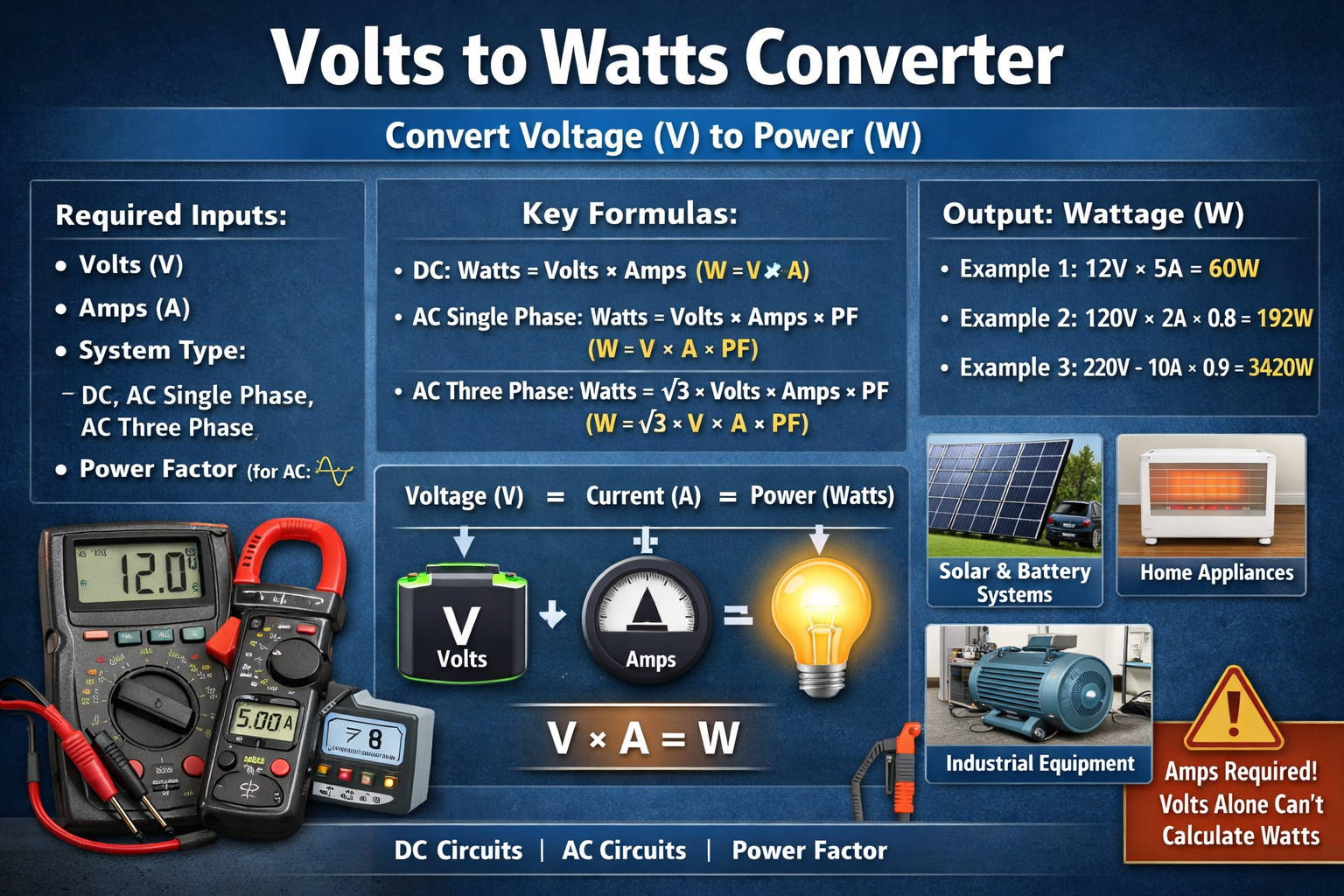
A volts to watts converter also called a V to W calculator, volt-to-watt tool, or voltage-to-wattage calculator that calculates electrical power in watts from voltage and current. The formula is W = V × A for DC systems and W = V × A × PF for AC systems. This tool is used to size solar inverters, battery setups, home circuits, generators, and automotive electronics.
Introduction
The volts to watts converter solves the most practical question in electrical work: how much power is a device actually consuming?
Voltage alone does not equal wattage. A 120V outlet does not draw 120 watts. What creates wattage is voltage combined with current — and in AC systems, the power factor as well. Converting volts to watts requires at least two values: voltage (V) and either current (A) or resistance (Ω).
The terms volts to watts, volt to watt, v to w, convert volts to watts, voltage to wattage, and voltage to watts conversion all refer to the same calculation. Whether you write it as “120v to watts” or “120 volts to watts” or “converting volts to watts,” the math is identical.
This guide covers the complete volts to watts conversion for DC, AC single phase, and AC three phase systems. It includes step-by-step instructions, every major formula, tables covering common voltages from 1V to 1200V with multiple current values, and direct answers to hundreds of searched questions about voltage-to-wattage conversion.
Inputs:
- Voltage (V)
- Current / Amps (A)
- System Type: DC / AC Single Phase / AC Three Phase
- Power Factor (PF) — for AC systems, default 1.0
- Resistance (Ω) — optional toggle when amps are unknown
Outputs:
- Watts (W)
- Kilowatts (kW)
How to Use the Volts to Watts Converter
Step 1 — Enter your voltage (V). Type the voltage value. Common values: 5V (USB), 9V (adapter), 12V (automotive/battery), 24V (solar/telecom), 48V (solar/EV), 120V (North America AC), 220V–240V (Europe/UK AC).
Step 2 — Enter current in amps (A). Type the current value. Find this on the device label, product manual, or measure it with a clamp meter.
Step 3 — Select system type. Choose DC, AC Single Phase, or AC Three Phase. DC applies to batteries, solar panels, and car electronics. AC Single Phase covers most household and small commercial circuits. AC Three Phase covers industrial equipment.
Step 4 — Enter power factor for AC (optional). For AC circuits with inductive loads, enter the power factor. Default 1.0 works for resistive loads. Use 0.8 as a conservative estimate for motors or compressors if PF is unknown.
Step 5 — Read your result. The converter outputs power in watts (W) and kilowatts (kW) instantly. No calculation needed.
Step 6 — Use resistance instead of amps (optional). If you know resistance in ohms (Ω) but not current, toggle to resistance mode. The tool calculates W = V² ÷ R automatically.
Quick Reference: Common Volts to Watts Answers
| Voltage | Current | System | Watts |
|---|---|---|---|
| 5V | 1A | DC | 5W |
| 5V | 2A | DC | 10W |
| 5V | 4A | DC | 20W |
| 9V | 1A | DC | 9W |
| 9V | 2A | DC | 18W |
| 9V | 3A | DC | 27W |
| 12V | 1A | DC | 12W |
| 12V | 5A | DC | 60W |
| 12V | 10A | DC | 120W |
| 12V | 20A | DC | 240W |
| 24V | 5A | DC | 120W |
| 48V | 10A | DC | 480W |
| 120V | 2A | AC (PF 1.0) | 240W |
| 120V | 10A | AC (PF 0.9) | 1,080W |
| 220V | 5A | AC (PF 1.0) | 1,100W |
| 240V | 10A | AC (PF 1.0) | 2,400W |
How Volts to Watts Conversion Works
The formula is: W = V × A
Watts equal volts multiplied by amps. This is the core relationship in electrical power calculation. For DC systems it applies directly. For AC systems, a power factor multiplier is added.
Electrical power (W) is the rate at which energy is used or produced. Voltage (V) is the electrical pressure driving current through a circuit. Current (A) is the flow of electrons, measured in amperes. When voltage pushes current through a load, the result is power in watts.
This relationship comes from Joule’s Law and connects directly to Ohm’s Law (V = I × R). All three formulas — W = V × A, V = I × R, and W = V² ÷ R — describe the same electrical system from different entry points depending on which values are known.
1 volt is not equal to 1 watt. Voltage and wattage are different units measuring different things. Volts measure electrical potential. Watts measure power , the product of voltage and current together. You cannot convert volts to watts from voltage alone. Current must be known.
The formula changes based on system type:
| System | Formula | Extra factor |
|---|---|---|
| DC | W = V × A | None |
| AC Single Phase | W = V × A × PF | Power factor |
| AC Three Phase | W = V × A × PF × 1.732 | PF and √3 |
| Any (resistance known) | W = V² ÷ R | Resistance |
DC Formula: W = V × A
For DC circuits: multiply volts by amps. That is the complete formula.
DC (direct current) has no power factor. Current flows in one direction. There is no phase shift between voltage and current. The wattage calculation is direct: W = V × A.
DC systems include batteries, solar panels (before the inverter), car electronics, RV and marine systems, USB power, and LED lighting. Most low-voltage electronics run on DC.
DC Volts to Watts Table
| Voltage (V) | Current (A) | Watts (W) |
|---|---|---|
| 3V | 0.5A | 1.5W |
| 3V | 1A | 3W |
| 3.3V | 1A | 3.3W |
| 3.7V | 1A | 3.7W |
| 5V | 0.5A | 2.5W |
| 5V | 1A | 5W |
| 5V | 2A | 10W |
| 5V | 2.4A | 12W |
| 5V | 3A | 15W |
| 5V | 4A | 20W |
| 5V | 5A | 25W |
| 9V | 1A | 9W |
| 9V | 2A | 18W |
| 9V | 3A | 27W |
| 12V | 1A | 12W |
| 12V | 2A | 24W |
| 12V | 3A | 36W |
| 12V | 4A | 48W |
| 12V | 5A | 60W |
| 12V | 10A | 120W |
| 12V | 20A | 240W |
| 12V | 50A | 600W |
| 19.5V | 3.3A | 64.4W |
| 19.5V | 4.7A | 91.7W |
| 24V | 2A | 48W |
| 24V | 5A | 120W |
| 24V | 10A | 240W |
| 48V | 10A | 480W |
| 48V | 20A | 960W |
AC Single Phase Formula: W = V × A × PF
For AC single phase: multiply volts by amps by power factor.
AC (alternating current) single phase is the standard power type in homes and small commercial buildings. The power factor (PF) adjusts for the phase difference between voltage and current that occurs with inductive or capacitive loads like motors, compressors, and transformers.
For purely resistive loads heaters, incandescent bulbs, simple heating elements — PF = 1 and the formula reduces to W = V × A. For motors, air conditioners, and fluorescent lights, PF is typically 0.7 to 0.95.
AC Single Phase Volts to Watts Table
| Voltage (V) | Current (A) | PF | Watts (W) |
|---|---|---|---|
| 110V | 5A | 1.0 | 550W |
| 110V | 10A | 0.9 | 990W |
| 115V | 5A | 1.0 | 575W |
| 115V | 10A | 0.85 | 977W |
| 120V | 1A | 1.0 | 120W |
| 120V | 2A | 1.0 | 240W |
| 120V | 5A | 0.9 | 540W |
| 120V | 10A | 0.9 | 1,080W |
| 120V | 15A | 0.85 | 1,530W |
| 220V | 2A | 1.0 | 440W |
| 220V | 5A | 1.0 | 1,100W |
| 220V | 10A | 0.9 | 1,980W |
| 230V | 4A | 1.0 | 920W |
| 230V | 5A | 0.9 | 1,035W |
| 230V | 10A | 0.85 | 1,955W |
| 240V | 5A | 1.0 | 1,200W |
| 240V | 10A | 0.9 | 2,160W |
| 240V | 15A | 1.0 | 3,600W |
| 240V | 20A | 0.9 | 4,320W |
AC Three Phase Formula: W = V × A × PF × 1.732
For AC three phase: multiply volts by amps by PF by 1.732 (the square root of 3).
Three phase AC power is used in industrial plants, commercial HVAC, large motors, three-phase generators, and industrial solar inverters. The 1.732 factor accounts for the three voltage phases offset by 120° each.
Without the √3 multiplier, power is significantly underestimated. A 240V three-phase system at 10A and PF 0.9 produces 3,742W not 2,160W as a single-phase calculation would suggest.
AC Three Phase Volts to Watts Table
| Voltage (V) | Current (A) | PF | Watts (W) |
|---|---|---|---|
| 208V | 10A | 0.85 | 3,057W |
| 208V | 20A | 0.9 | 6,485W |
| 240V | 10A | 0.9 | 3,742W |
| 240V | 20A | 0.85 | 7,063W |
| 400V | 10A | 0.85 | 5,888W |
| 400V | 20A | 0.9 | 12,470W |
| 415V | 10A | 0.85 | 6,108W |
| 440V | 10A | 0.85 | 6,480W |
| 480V | 30A | 0.85 | 21,211W |
Converting Volts to Watts Without Amps
Yes , if you know resistance in ohms, use: W = V² ÷ R
When current is unknown but resistance is known, Ohm’s Law provides an alternative path. This formula works for purely resistive loads: heating elements, resistors, and components with a fixed, measurable resistance value.
It does not work for inductive or capacitive loads like motors, because those loads have reactive impedance that changes the relationship between voltage and current.
Volts to Watts Using Resistance (W = V² ÷ R)
| Voltage (V) | Resistance (Ω) | Watts (W) |
|---|---|---|
| 5V | 5Ω | 5W |
| 9V | 9Ω | 9W |
| 12V | 4Ω | 36W |
| 12V | 10Ω | 14.4W |
| 24V | 12Ω | 48W |
| 120V | 60Ω | 240W |
| 120V | 100Ω | 144W |
| 230V | 50Ω | 1,058W |
| 240V | 80Ω | 720W |
Master Formula and Real-World Table
All Volts to Watts Formulas in One Place
| System | Formula | When to Use |
|---|---|---|
| DC | W = V × A | Batteries, solar panels, car electronics, USB |
| AC Single Phase | W = V × A × PF | Household circuits, small commercial |
| AC Three Phase | W = V × A × PF × 1.732 | Industrial motors, commercial HVAC |
| Resistance known | W = V² ÷ R | Resistive elements when current is unknown |
| Current and resistance | W = A² × R | When voltage is unknown |
Real-World Device Wattage Examples
| Device | Voltage | Current | System | PF | Watts |
|---|---|---|---|---|---|
| USB charger | 5V | 1A | DC | — | 5W |
| USB-C fast charger | 5V | 3A | DC | — | 15W |
| LED bulb | 120V | 0.1A | AC | 0.9 | 10.8W |
| Laptop charger | 19.5V | 3.3A | DC | — | 64W |
| Desktop computer | 120V | 5A | AC | 0.9 | 540W |
| Refrigerator | 120V | 6A | AC | 0.8 | 576W |
| Window AC unit | 120V | 10A | AC | 0.9 | 1,080W |
| Car stereo | 12V | 5A | DC | — | 60W |
| Car inverter | 12V | 20A | DC | — | 240W |
| Solar panel | 48V | 8A | DC | — | 384W |
| Electric dryer | 240V | 20A | AC | 1.0 | 4,800W |
| Industrial motor | 400V | 15A | AC 3-ph | 0.85 | 8,832W |
| EV charger (L2) | 240V | 32A | AC | 1.0 | 7,680W |
Voltage-Specific Conversion Tables
This section directly answers the most searched voltage-to-wattage questions. All DC calculations use W = V × A. AC calculations include PF where noted.
1 Volt to Watts
1 volt is not equal to 1 watt. 1V requires current to produce watts. At 1A: 1V × 1A = 1W. At 5A: 1V × 5A = 5W. Voltage alone cannot be converted to watts , current must be specified.
| Voltage | Current | Watts |
|---|---|---|
| 1V | 1A | 1W |
| 1V | 2A | 2W |
| 1V | 5A | 5W |
| 1V | 10A | 10W |
3V to Watts (3 Volts to Watts)
| Voltage | Current | Watts |
|---|---|---|
| 3V | 0.5A | 1.5W |
| 3V | 1A | 3W |
| 3V | 2A | 6W |
| 3V | 3A | 9W |
| 3.3V | 1A | 3.3W |
| 3.6V | 1A | 3.6W |
| 3.7V | 1A | 3.7W |
5V to Watts (5 Volts to Watts)
5V is the standard USB voltage. What is 5V in watts? It depends on current. A standard USB 2.0 port at 0.5A delivers 2.5W. A USB fast charger at 3A delivers 15W. A 5V 4A adapter = 20W.
| Voltage | Current | Watts |
|---|---|---|
| 5V | 0.5A | 2.5W |
| 5V | 1A | 5W |
| 5V | 1.5A | 7.5W |
| 5V | 2A | 10W |
| 5V | 2.1A | 10.5W |
| 5V | 2.4A | 12W |
| 5V | 3A | 15W |
| 5V | 4A | 20W |
| 5V | 5A | 25W |
9V to Watts (9 Volts to Watts)
9V is used in guitar pedals, smoke detectors, and wall adapters. How many watts is 9V? At 1A = 9W. At 2A = 18W. At 3A = 27W.
| Voltage | Current | Watts |
|---|---|---|
| 9V | 0.5A | 4.5W |
| 9V | 1A | 9W |
| 9V | 2A | 18W |
| 9V | 3A | 27W |
| 9V | 4A | 36W |
12V to Watts (12 Volts to Watts)
12V is the standard automotive, marine, and RV battery voltage. How many watts is a 12V battery? It depends entirely on current draw.
| Voltage | Current | Watts |
|---|---|---|
| 12V | 0.5A | 6W |
| 12V | 1A | 12W |
| 12V | 2A | 24W |
| 12V | 3A | 36W |
| 12V | 4A | 48W |
| 12V | 5A | 60W |
| 12V | 10A | 120W |
| 12V | 15A | 180W |
| 12V | 20A | 240W |
| 12V | 30A | 360W |
| 12V | 50A | 600W |
| 12V | 100A | 1,200W |
24V to Watts (24 Volts to Watts)
24V is common in solar battery banks, telecom systems, and industrial control systems.
| Voltage | Current | Watts |
|---|---|---|
| 24V | 1A | 24W |
| 24V | 2A | 48W |
| 24V | 5A | 120W |
| 24V | 10A | 240W |
| 24V | 20A | 480W |
| 24V | 50A | 1,200W |
48V to Watts (48 Volts to Watts)
48V is used in large solar systems, EV battery packs, and telecom infrastructure.
| Voltage | Current | Watts |
|---|---|---|
| 48V | 5A | 240W |
| 48V | 10A | 480W |
| 48V | 20A | 960W |
| 48V | 30A | 1,440W |
| 48V | 50A | 2,400W |
110V / 115V to Watts
110V and 115V are used in North American AC circuits. How many watts is 110 volts? At 5A = 550W. At 10A = 1,100W (PF 1.0).
| Voltage | Current | PF | Watts |
|---|---|---|---|
| 110V | 5A | 1.0 | 550W |
| 110V | 10A | 1.0 | 1,100W |
| 110V | 15A | 0.9 | 1,485W |
| 115V | 5A | 1.0 | 575W |
| 115V | 10A | 0.9 | 1,035W |
| 115V | 15A | 0.85 | 1,466W |
120V to Watts (120 Volts to Watts)
120V is the standard North American household voltage. How many watts is 120V? Watts depend on current. 120V at 2A = 240W. 120V at 10A at PF 0.9 = 1,080W.
| Voltage | Current | PF | Watts |
|---|---|---|---|
| 120V | 0.5A | 1.0 | 60W |
| 120V | 1A | 1.0 | 120W |
| 120V | 2A | 1.0 | 240W |
| 120V | 5A | 1.0 | 600W |
| 120V | 5A | 0.9 | 540W |
| 120V | 10A | 1.0 | 1,200W |
| 120V | 10A | 0.9 | 1,080W |
| 120V | 12A | 1.0 | 1,440W |
| 120V | 15A | 1.0 | 1,800W |
| 120V | 15A | 0.85 | 1,530W |
| 120V | 20A | 1.0 | 2,400W |
120V 60Hz to watts: The 60Hz frequency does not affect wattage directly. 120V 60Hz at 10A = 1,200W at PF 1.0.
120 VAC to watts: VAC means AC volts. Use the AC single phase formula: W = 120 × A × PF.
220V to Watts (220 Volts to Watts)
220V is the standard voltage in many countries and for heavy appliances in North America. How many watts is 220V? At 5A (PF 1.0) = 1,100W. At 10A (PF 0.9) = 1,980W.
| Voltage | Current | PF | Watts |
|---|---|---|---|
| 220V | 1A | 1.0 | 220W |
| 220V | 2A | 1.0 | 440W |
| 220V | 3A | 1.0 | 660W |
| 220V | 5A | 1.0 | 1,100W |
| 220V | 5A | 0.9 | 990W |
| 220V | 10A | 0.9 | 1,980W |
| 220V | 10A | 0.85 | 1,870W |
| 220V | 15A | 0.9 | 2,970W |
| 220V | 20A | 0.85 | 3,740W |
220V 2A to watts: 220 × 2 × 1.0 = 440W. 220V 3A to watts: 220 × 3 × 1.0 = 660W. 220V 5A to watts: 220 × 5 × 1.0 = 1,100W. 220V 10A to watts: 220 × 10 × 0.9 = 1,980W.
230V to Watts (230 Volts to Watts)
230V is the standard household voltage in Europe, the UK, Australia, and much of Asia.
| Voltage | Current | PF | Watts |
|---|---|---|---|
| 230V | 1A | 1.0 | 230W |
| 230V | 2A | 1.0 | 460W |
| 230V | 4A | 1.0 | 920W |
| 230V | 5A | 0.9 | 1,035W |
| 230V | 10A | 0.85 | 1,955W |
| 230V | 13A | 1.0 | 2,990W |
| 230V | 16A | 0.9 | 3,312W |
240V to Watts (240 Volts to Watts)
240V is used for heavy appliances in North America (dryers, ranges) and as the standard household voltage in many countries. How many watts is 240V? At 10A (PF 1.0) = 2,400W.
| Voltage | Current | PF | Watts |
|---|---|---|---|
| 240V | 1A | 1.0 | 240W |
| 240V | 2A | 1.0 | 480W |
| 240V | 5A | 1.0 | 1,200W |
| 240V | 10A | 1.0 | 2,400W |
| 240V | 10A | 0.9 | 2,160W |
| 240V | 15A | 1.0 | 3,600W |
| 240V | 20A | 0.9 | 4,320W |
| 240V | 30A | 1.0 | 7,200W |
| 240V | 32A | 1.0 | 7,680W |
240V 10A to watts: 240 × 10 × 1.0 = 2,400W. 240 VAC to watts: Use AC single phase formula: W = 240 × A × PF. 240V 60Hz to watts: Frequency does not change the formula. 240V 60Hz at 10A = 2,400W at PF 1.0.
Other Common Voltages — Watts at Various Currents
| Voltage | 1A | 2A | 5A | 10A |
|---|---|---|---|---|
| 6V | 6W | 12W | 30W | 60W |
| 10V | 10W | 20W | 50W | 100W |
| 14.4V | 14.4W | 28.8W | 72W | 144W |
| 18V | 18W | 36W | 90W | 180W |
| 19.5V | 19.5W | 39W | 97.5W | 195W |
| 21.6V | 21.6W | 43.2W | 108W | 216W |
| 22.2V | 22.2W | 44.4W | 111W | 222W |
| 25.2V | 25.2W | 50.4W | 126W | 252W |
| 36V | 36W | 72W | 180W | 360W |
| 100V | 100W | 200W | 500W | 1,000W |
| 127V | 127W | 254W | 635W | 1,270W |
| 250V | 250W | 500W | 1,250W | 2,500W |
| 440V | 440W | 880W | 2,200W | 4,400W |
| 480V | 480W | 960W | 2,400W | 4,800W |
| 600V | 600W | 1,200W | 3,000W | 6,000W |
| 860V | 860W | 1,720W | 4,300W | 8,600W |
| 1100V | 1,100W | 2,200W | 5,500W | 11,000W |
Volts to Watts With Amps — V × A Reference Table
This table covers the most searched V × A combinations directly.
| V | A | Watts | Common Use |
|---|---|---|---|
| 5V | 1A | 5W | USB 2.0 charging |
| 5V | 2A | 10W | Standard USB charger |
| 5V | 2.1A | 10.5W | iPad USB charger |
| 5V | 2.4A | 12W | Fast USB charger |
| 5V | 3A | 15W | USB-C standard |
| 5V | 4A | 20W | USB-C fast charge |
| 9V | 2A | 18W | USB-C PD 18W |
| 9V | 3A | 27W | USB-C PD 27W |
| 11V | 3A | 33W | Laptop adapter |
| 11V | 4A | 44W | Laptop adapter |
| 12V | 2A | 24W | Router/modem adapter |
| 12V | 4A | 48W | Laptop DC adapter |
| 12V | 5A | 60W | Small inverter load |
| 20V | 2A | 40W | Laptop charger |
| 20V | 4A | 80W | Laptop charger |
| 24V | 2A | 48W | LED driver |
| 24V | 5A | 120W | Solar charge controller |
| 28V | 5A | 140W | Telecom system |
| 220V | 2A | 440W | Small AC appliance |
| 220V | 5A | 1,100W | AC appliance |
| 220V | 10A | 2,200W | Larger AC appliance |
| 230V | 4A | 920W | European appliance |
| 240V | 10A | 2,400W | Heavy appliance |
| 240V | 15A | 3,600W | Electric range/dryer |
Use Cases
Solar Systems
The volts to watts converter is core to solar system design. Solar panels produce DC voltage and current. Their watt output determines power into batteries or inverters.
How to size a solar system using volts to watts conversion:
- Find panel maximum power point voltage (Vmp) and current (Imp) from the datasheet
- Calculate panel watts: W = Vmp × Imp
- Multiply per-panel watts by panel count for array total
- Match inverter watt rating to or above array output
- Size battery bank in Wh: multiply battery voltage by amp-hour capacity
Example: A 10-panel array with each panel rated at 48V × 8A = 384W produces 3,840W total. A 4,000W inverter covers this comfortably.
Battery Setups
Battery systems are rated in voltage (V) and amp-hours (Ah). Watts describe instantaneous power delivery. Watt-hours (Wh) describe total stored energy.
Wh = V × Ah. A 12V 100Ah battery stores 1,200Wh (1.2 kWh).
How many watts is a 12V battery? It depends on the current draw: 12V at 10A = 120W. 12V at 50A = 600W. 12V at 100A = 1,200W (typical peak for a car starter battery).
Home Electrical Systems
Home circuits in North America run at 120V (standard outlets) and 240V (large appliances). A 15A circuit at 120V safely handles 1,800W (120 × 15). A 20A circuit handles 2,400W.
Practical applications: checking whether a 15A breaker can handle additional appliances, calculating total watts on a multi-outlet extension cord, and estimating monthly electricity cost from watts × hours = Wh ÷ 1,000 = kWh.
Automotive and Car Electronics
Car electrical systems run on 12V DC. Wattage determines fuse size, wire gauge, and alternator output requirements.
Common automotive calculations: car stereo at 12V × 5A = 60W, LED light bar at 12V × 15A = 180W, car inverter at 12V × 20A = 240W output, winch peak draw at 12V × 400A = 4,800W (requires heavy cabling).
Generator-Based Systems
A generator rated at 120V × 20A produces 2,400W. Running a 1,200W refrigerator + 600W microwave + 400W sump pump = 2,200W — just within the safe operating limit.
For three-phase generators: use W = V × A × PF × 1.732.
Power Supplies and Electronics Lab
Bench power supplies and computer PSUs list voltage and current ratings. Use the converter to confirm watt output before connecting components.
Example: A bench supply set to 24V delivering 3A outputs 72W. A 19.5V laptop adapter at 4.7A delivers 91.7W — the wattage stamped on many laptop bricks.
Key Concepts
What Is Voltage (V)?
Voltage is electrical potential difference, measured in volts (V). It is the “pressure” driving current through a circuit. Higher voltage with the same resistance produces more current and more power. Common voltages: 5V (USB), 12V (automotive), 48V (solar), 120V (North America AC), 230–240V (Europe/UK AC), 400V (industrial three-phase).
What Is Current (A)?
Current is the flow of electric charge through a conductor, measured in amperes (A or amps). It determines heat generated in wires and components — the reason breakers, fuses, and wire gauges are rated in amps, not volts.
What Is Electrical Power (W)?
Electrical power is the rate of energy consumption or production, measured in watts (W). One watt = one joule per second. Kilowatts (kW) = W ÷ 1,000. Kilowatt-hours (kWh) = kW × hours — the unit on your electricity bill.
What Is Power Factor (PF)?
Power factor is the ratio of real power (W) to apparent power (VA) in an AC circuit. It ranges from 0 to 1 and only applies to AC — never to DC. PF = 1 for resistive loads (heaters, incandescent bulbs). PF < 1 for inductive loads (motors, compressors).
Typical Power Factor by Device
| Device | Typical PF |
|---|---|
| Electric heater | 1.0 |
| Incandescent bulb | 1.0 |
| LED bulb (quality driver) | 0.90–0.95 |
| Computer PSU (80 Plus) | 0.90–0.99 |
| Microwave | 0.90–0.95 |
| Air conditioner | 0.80–0.90 |
| Induction motor | 0.75–0.90 |
| Fluorescent light | 0.50–0.70 |
What Is Ohm’s Law?
Ohm’s Law: V = I × R. Combined with W = V × I this produces W = V² ÷ R (power from voltage and resistance) and W = I² × R (power from current and resistance).
DC vs. AC — Key Differences
| Property | DC | AC Single Phase | AC Three Phase |
|---|---|---|---|
| Current direction | One way | Alternates | Alternates (3 phases) |
| Power formula | W = V × A | W = V × A × PF | W = V × A × PF × 1.732 |
| Power factor needed | No | Yes (inductive loads) | Yes |
| Common voltages | 5V, 12V, 24V, 48V | 110V, 120V, 220V, 230V, 240V | 208V, 400V, 415V, 480V |
| Common uses | Batteries, solar, automotive | Homes, offices | Industrial, commercial |
Volt-Amps (VA) vs. Watts (W)
VA is apparent power: VA = V × A. W is real power: W = V × A × PF. These are equal only when PF = 1. For inductive loads, W is always less than VA. UPS units, generators, and transformers are rated in VA because they handle apparent power.
Volts to Watt-Hours (Wh)
Watts measure instantaneous power. Watt-hours measure energy over time. Wh = W × hours. For a battery: Wh = V × Ah. Example: a 12V 50Ah battery stores 600Wh. At 60W draw (12V × 5A), it lasts 10 hours.FAQ
How many watts is 120 volts?
120 volts alone is not a watt value. Watts require voltage and current. At 1A: 120V × 1A = 120W. At 10A with PF 0.9: 120V × 10A × 0.9 = 1,080W. To find watts from 120V, multiply by the current draw and the power factor for AC loads.
How many watts is 220 volts?
220V is not a fixed wattage. 220V × 5A × PF 1.0 = 1,100W. 220V × 10A × PF 0.9 = 1,980W. Wattage depends on what load is connected to the 220V supply, not the voltage alone.
How many watts is 240 volts?
240V at 10A (PF 1.0) = 2,400W. At 15A = 3,600W. At 20A with PF 0.9 = 4,320W. The formula is W = 240 × A × PF for AC single phase.
What is 120V in watts?
120V in watts depends on current. A 120V circuit drawing 2A delivers 240W. At 5A = 600W. At 10A with PF 0.9 = 1,080W. Use W = V × A × PF for AC circuits.
What is 5V in watts?
5V in watts depends on current. 5V × 1A = 5W. 5V × 2A = 10W. 5V × 3A = 15W. 5V × 4A = 20W. This is the standard USB DC calculation — no power factor needed.
How many watts is a 12V battery?
A 12V battery’s wattage equals 12 × the current it delivers. At 10A = 120W. At 50A = 600W. At 100A = 1,200W. The amp-hour (Ah) rating determines how long the battery sustains that current. A 100Ah battery at 10A lasts approximately 10 hours, delivering 1,200Wh total.
What is 9V in watts?
9V × 1A = 9W. 9V × 2A = 18W. 9V × 3A = 27W. 9V is a DC voltage, so the formula is simply W = V × A. No power factor applies.
Can I convert volts to watts without amps?
Yes, if you know resistance in ohms: W = V² ÷ R. Example: 120V at 60Ω resistance = 120² ÷ 60 = 240W. Without current or resistance, watts cannot be calculated from voltage alone.
How do I convert volts to watts?
Multiply volts by amps. For DC: W = V × A. For AC single phase: W = V × A × PF. For AC three phase: W = V × A × PF × 1.732. If you have resistance instead of current: W = V² ÷ R.
What is the formula for converting volts to watts?
The four formulas are: (1) DC: W = V × A. (2) AC Single Phase: W = V × A × PF. (3) AC Three Phase: W = V × A × PF × 1.732. (4) Resistance known: W = V² ÷ R. Choose based on system type and which values are known.
How many watts is 110 volts?
110V × 5A × PF 1.0 = 550W. 110V × 10A × PF 0.9 = 990W. 110V × 15A × PF 0.85 = 1,402W. The formula is W = 110 × A × PF for AC circuits.
How many watts is 115 volts?
115V × 5A × PF 1.0 = 575W. 115V × 10A × PF 0.85 = 977W. 115V × 15A × PF 0.9 = 1,552W. For 115V 60Hz circuits, the frequency does not change the wattage formula.
How many watts is 24 volts?
24V is DC in most applications. 24V × 5A = 120W. 24V × 10A = 240W. 24V × 20A = 480W. For a 24V AC system, multiply by current and PF.
How many watts is 48 volts?
48V × 10A = 480W. 48V × 20A = 960W. 48V × 50A = 2,400W. 48V is common in large solar battery banks and telecom systems. All DC: W = V × A.
How does power factor affect wattage calculation?
Power factor reduces actual watts below the apparent volt-amp figure in AC circuits. A 120V × 10A circuit has 1,200 VA apparent power. At PF 0.8: actual watts = 1,200 × 0.8 = 960W. The difference (240 VA) is reactive power — it loads the wiring but performs no useful work. Power factor does not apply to DC circuits.
Is 1 volt equal to 1 watt?
No. 1 volt is not equal to 1 watt. Watts = volts × amps. 1V produces 1W only when 1A of current flows. Without knowing the current, a voltage value cannot be converted to watts.
What is the difference between volts and watts?
Volts measure electrical potential (pressure). Watts measure electrical power (work rate). They are different quantities. Volts × Amps = Watts. A 12V source connected to a 10A load produces 120W. Neither the 12V nor the 10A alone defines the wattage.
How many watts are in a volt?
There is no fixed number of watts in a volt. Watts depend on both voltage and current: W = V × A. 1 volt at 1 amp = 1 watt. 1 volt at 100 amps = 100 watts.
How do I calculate watts from volts and amps?
For DC: W = V × A. Example: 12V × 5A = 60W. For AC single phase: W = V × A × PF. Example: 120V × 5A × 0.9 = 540W. For AC three phase: W = V × A × PF × 1.732.
What is 48V in watts?
48V in watts depends on current. 48V × 10A = 480W. 48V × 20A = 960W. 48V × 50A = 2,400W. Without knowing the current, 48V cannot be expressed as watts.
How many watts is 860 volts?
860V × 1A = 860W. 860V × 10A = 8,600W. 860V × 100A = 86,000W. 860V is an industrial or transmission voltage. Use W = V × A × PF for AC systems at this voltage.
How many watts is 440 volts?
440V is an industrial three-phase voltage. Using three-phase formula at 10A and PF 0.85: 440 × 10 × 0.85 × 1.732 = 6,480W. For AC single phase at 10A: 440 × 10 × 0.85 = 3,740W.
What is volt-ampere (VA) and how does it differ from watts?
Volt-amperes (VA) is apparent power: VA = V × A. Watts (W) is real power: W = V × A × PF. VA equals watts only when PF = 1. For inductive loads, VA > W. UPS units, generators, and transformers are rated in VA because they must handle apparent power.
How to convert volts to watts for DC circuits?
For DC: W = V × A. No power factor needed. Multiply voltage by current. Example: 48V × 20A = 960W. DC circuits include batteries, solar panels, car systems, and USB power.
What is 120V 60Hz in watts?
The 60Hz frequency describes how often the AC current reverses per second. It does not directly affect wattage. 120V 60Hz at 10A = 1,200W at PF 1.0. Same formula: W = V × A × PF.
What is 240 VAC in watts?
240 VAC uses the AC single phase formula: W = 240 × A × PF. At 10A PF 1.0: 2,400W. At 20A PF 0.9: 4,320W.
How many watts is 100-240V?
100-240V is the input range on universal power adapters — it means the device operates anywhere in that voltage range. Actual wattage depends on the specific supply voltage and current drawn. At 100V × 2A = 200W. At 240V × 2A = 480W.
What is 19.5V in watts?
19.5V is the output of many laptop adapters. 19.5V × 3.3A = 64.4W. 19.5V × 4.7A = 91.7W. 19.5V × 6.7A = 130.7W — matching common 65W, 90W, and 130W laptop adapter ratings.
How many watts is 5V 4A?
5V × 4A = 20W. This is a standard USB Power Delivery (PD) configuration used in fast chargers for phones and tablets.
How many watts is 11V 3A?
11V × 3A = 33W. 11V × 4A = 44W. These values appear in laptop and battery adapter ratings.
What is 220V in watts?
220V in watts depends on current. 220V × 2A = 440W. 220V × 5A = 1,100W. 220V × 10A × PF 0.9 = 1,980W. Use W = V × A × PF for all 220V AC calculations.
How many watts is 230 volts?
230V × 5A × PF 0.9 = 1,035W. 230V × 10A × PF 0.85 = 1,955W. 230V is the standard household voltage in Europe, the UK, and Australia.
What is 9V equals how many watts?
9V equals as many watts as its current allows. 9V × 1A = 9W. 9V × 2A = 18W. 9V × 3A = 27W. Watts cannot be determined from voltage alone.
How many watts is 20 volts?
20V × 2A = 40W. 20V × 4A = 80W. 20V × 5A = 100W. 20V is common in laptop chargers (USB-C PD standard).
How many watts is 36 volts?
36V × 5A = 180W. 36V × 10A = 360W. 36V × 20A = 720W. 36V appears in e-bike battery packs and power tool batteries.
What is 25.2V in watts?
25.2V × 1A = 25.2W. 25.2V × 2A = 50.4W. 25.2V × 5A = 126W. 25.2V is the full-charge voltage of a 6-cell lithium-ion battery pack (6 × 4.2V = 25.2V).
How many watts is 21.6V?
21.6V × 1A = 21.6W. 21.6V × 2A = 43.2W. 21.6V × 5A = 108W. 21.6V is the nominal voltage of some Dyson and power tool batteries.
How do you convert volts to watts?
Identify whether the system is DC or AC. For DC: multiply volts by amps (W = V × A). For AC single phase: multiply volts by amps by power factor (W = V × A × PF). For AC three phase: use W = V × A × PF × 1.732. If only resistance is known: W = V² ÷ R.
What is the volts to watts equation?
The volts to watts equation has four forms: W = V × A for DC, W = V × A × PF for AC single phase, W = V × A × PF × 1.732 for AC three phase, and W = V² ÷ R when resistance is known instead of current.
Can you convert volts to watts without amps?
Yes, using resistance: W = V² ÷ R. If neither amps nor resistance is known, watts cannot be calculated from voltage alone. Voltage is potential — not power.
How many watts is 12 amps at 120 volts?
120V × 12A × PF 1.0 = 1,440W. At PF 0.9: 120 × 12 × 0.9 = 1,296W. This is a common calculation for North American household circuits with a 15A breaker, confirming that 12A load is within the safe limit.
What is 5V 2A in watts?
5V × 2A = 10W. This is the output of a standard USB charger. No power factor needed — it is DC.
How many watts is 120V 15A?
120V × 15A × PF 1.0 = 1,800W. At PF 0.85: 120 × 15 × 0.85 = 1,530W. A standard 15A household circuit at 120V can safely handle up to 1,800W of resistive load.
Related Electrical Calculators
- Watts to Volts Converter — inverse: find voltage from watts and amps
- Amps to Watts Calculator — convert current to power at a given voltage
- Watts to Amps Calculator — find current draw from wattage and voltage
- Ohm’s Law Calculator — solve for V, I, or R from any two known values
- kWh Calculator — convert watts and usage hours to energy consumed
- Solar Panel Wattage Calculator — size panels and arrays
- Power Factor Calculator — calculate PF from real and apparent power
- Volt-Amps to Watts Calculator — convert VA to W using power factor
Author: John Smith — Electrical systems writer specializing in solar, DC power, and home electrical calculations. Last updated: March 2026.